| Product Name |
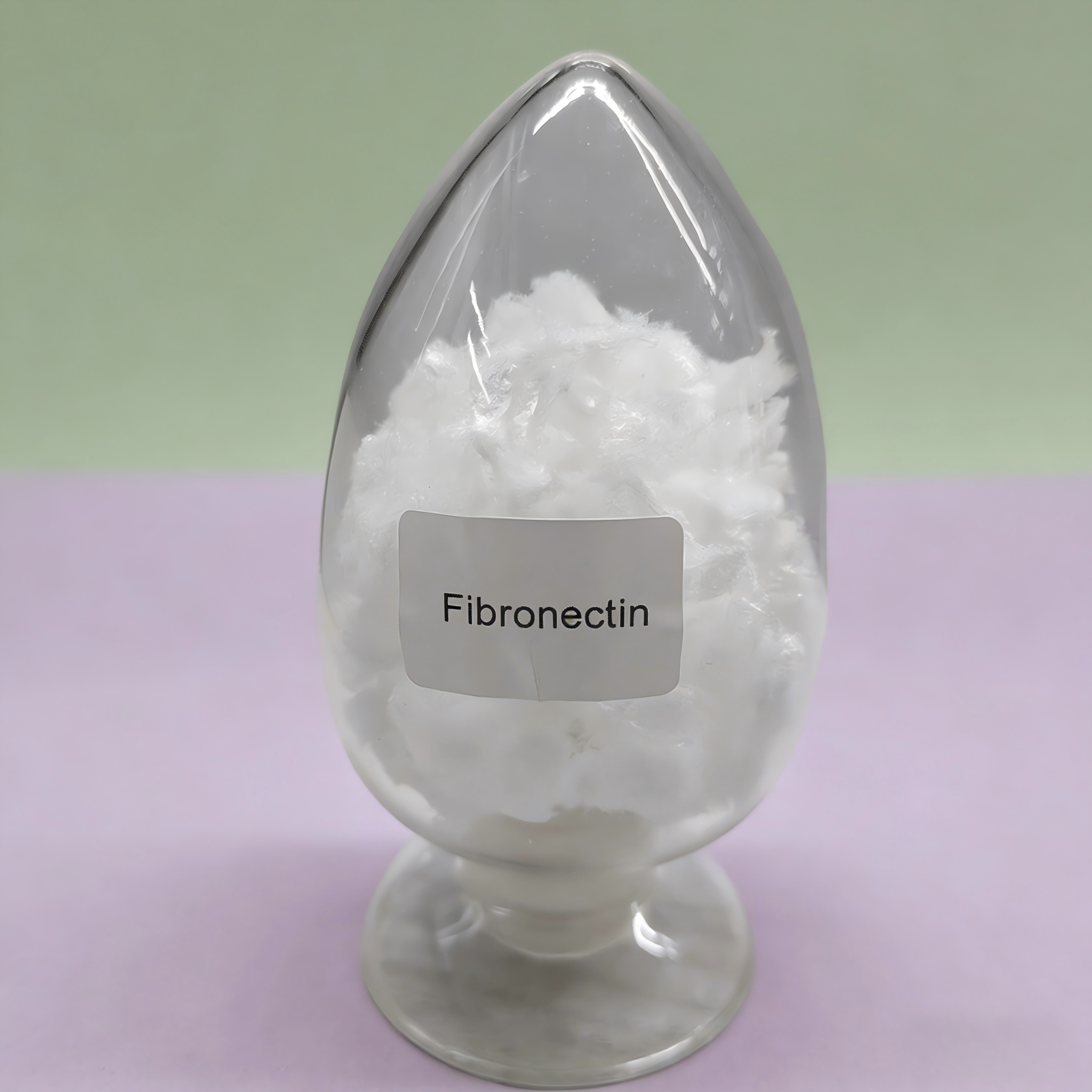
Fibronectin |
| Product Specification |
10g/bag |
| Endotoxin |
≤0.5EU/mg |
| Performance Advantages |
Selecting and recombinantly expressing fibronectin fragments that interact with cells yields a recombinant fibronectin that effectively promotes cell proliferation and migration. |
| Application Scope |
Bone repair material
Hair growth
Skin care |
Advance your regenerative medicine and tissue engineering applications with our Recombinant Fibronectin (Cell-Binding Domain Fragment) . Unlike full-length fibronectin extracted from animal sources, our product is rationally designed to include only the functionally essential domains that interact directly with cells, ensuring maximum bioactivity and minimal batch-to-batch variability.
Scientific Design Rationale:
Minimal High-Activity Domain: Our recombinant fragment consists of the ninth and tenth type III modules (FNIII9-10) of human fibronectin, which includes the RGD cell recognition site (FNIII10) and the PHSRN synergistic site (FNIII9) . This 20kDa fragment retains the full cell adhesive activity of the native 110kDa fragment when properly presented .
Dual-Site Synergy: The PHSRN sequence acts synergistically with RGD to enhance binding affinity for integrin α5β1, the primary fibronectin receptor, resulting in superior cell adhesion, spreading, and migration compared to RGD-only peptides .
Proven Bioactivity: This fragment promotes both cell spreading and migration specifically mediated by α5β1 integrin, and effectively binds α5-, α3-, and αv-containing fibronectin-binding integrins .
Key Technical Advantages:
Targeted Activity: Contains only the cell-interacting domains, eliminating non-functional sequences.
Ultra-High Purity: >99% via HPLC, free from animal-derived contaminants.
Excellent Solubility: Lyophilized powder readily dissolves in aqueous buffers.
Consistent Quality: E. coli expression ensures batch-to-batch reproducibility.
Bone Repair Applications:
Recent research demonstrates that fibronectin 1 (FN-1) promotes differentiation and mineralization of osteoblasts by activating WNT/β-catenin signaling via integrin β1 interaction . FN-1 is involved in osteoblast compaction through FN-fibrillogenesis cell-mediated matrix assembly processes, essential for osteoblast mineralization . Supplying FN-1 provides a potential therapeutic strategy for improving bone formation .
Supplied as lyophilized powder in 10g/bag packaging. Ideal for bone graft materials, osteogenic scaffolds, and orthopedic device coatings.

 EN
EN